
From Memos to Demos: Staying Relevant by Being an AI Builder
On back-to-back days in December, two clients described how they were engaging with AI. One was preparing to write a strategy memo about how her company should use AI in part of its operation. The other was getting her hands dirty by building AI-powered tools for her team.
The memo v. demo contrast struck me immediately.
My starting point was that almost everyone understands the potential of AI—there’s no shortage of opinions about its potential implications. At the same time, I often see a canyon-wide gap between how people talk about AI’s potential and the extent to which they’ve integrated it into their individual work or how their teams operate.
At a visceral level, I imagined the difference between someone sending me a concept paper on AI and someone sending me a link to a working application that uses AI. Even if the demo were a rough first draft and the concept paper were dissertation-level quality, I’d be way more excited to engage with the demo.
I suspect most people would also see the person who created the demo as knowing more about the topic than the memo writer. In that sense, building hands-on knowledge may be critical to helping people remain competitive in a changing world. Put plainly, I’d bet that the 40-something executive who relies solely on their knowledge and experience will eventually lose out to the AI-augmented 20-something junior staff member. I worry about that for both the people I work with and for myself.
I worry about that for both the people I work with and for myself. Those conversations helped me realize that I haven’t spent enough time directly building tools, which means I don’t have a strong enough handle on the technology itself or the practical hurdles people and organizations face when adopting them. Because of that, I’ve set a goal of creating at least ten tools this quarter that are built with AI and powered by AI.
Here are a few insights I’ve gained so far.
1. Willingness to Become a Beginner Again
The first insight I had was how humbling it was to start from scratch. For example, having not written code in the last ten years, I didn’t even have the right software on my laptop. I’d also forgotten basic skills, like how to save my work to cloud repositories. Hence, the learning process required me to depart from the comfortable world of my areas of expertise and dwell in the uncomfortable world of being lost.
The good news, of course, is that the AI tools—I used Claude—are great guides for (re)starting as a novice. My original prompt included, “Walk me through the steps—everything from setting up infrastructure to writing code. I have some experience in coding, but have not done it recently.” So while Claude did the heavy lifting of writing functions, including in languages I didn’t know, it was easy to get reacquainted with thinking like a software developer.
I mention all that because when I started to create the second tool, I forgot to specifically ask for step-by-step guidance. As a result, Claude asked about 30 questions and then built the entire app. It was amazing to see it produce the app that quickly, but it created another problem: the code was much harder to understand. I could still prompt the AI to fix any issues (“It’s not working, change this”), but having AI do more of the work decreased my ability to directly edit the code, which runs counter to my learning goal.
2. Knowing WHAT to Build Matters Most
The second reflection I had was that once someone reaches the minimum skill level, AI has the potential to lower the technical bar for creating interesting tools. For example, the first app I built mimicked the conversation I have with my wife during our annual strategy retreat. (Screenshot below, filled with dummy data.)
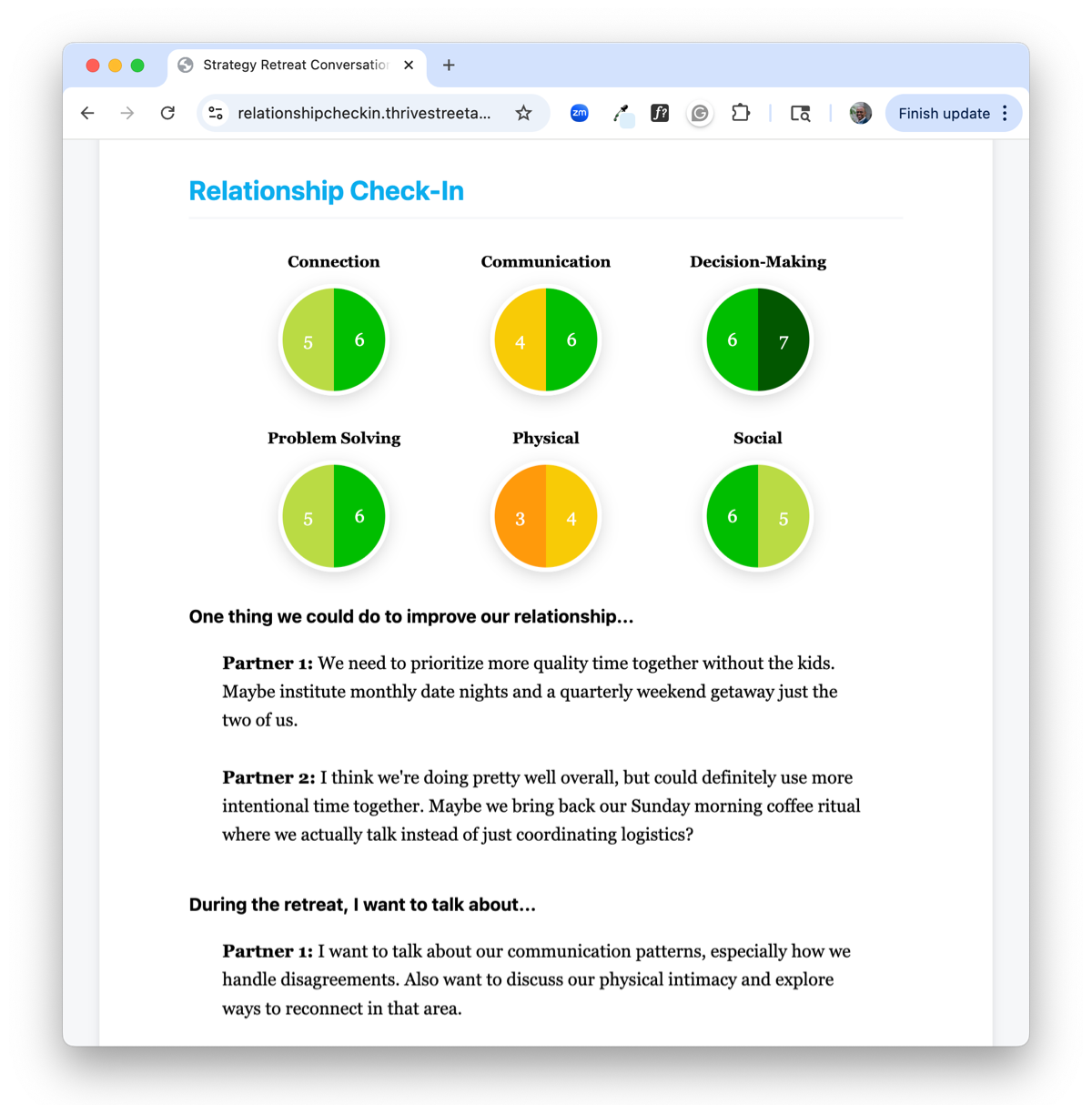
When starting the exercise, I told Claude, “Ask questions to help refine the goal and help us get started.”
The most important questions weren’t about the technical aspects of the app—e.g., what information to collect or where to use AI versus hard-coding an analysis. Instead, the most important questions were about what makes the app valuable. What are you trying to accomplish? What kinds of insights are most useful? What do you want the user to do with the information?
The only way to know the right answers to those questions is by having a deep understanding of how the tool needs to work in real life. That’s a helpful notion for those of us who aren’t technologists. Anyone can write code or create an AI agent to perform analysis or generate reports, but only those with experience will know which analyses, visualizations, or tone will resonate with the specific people who will consume them. The burden shifts from knowing how to build to knowing what to build, and that’s where those with experience can shine.
This mirrors a broader observation about AI: it’s a force multiplier, but only when you have enough experience to shape it, check it, and point it in the right direction.
3. The Demo-First Mindset
A friend of mine, an AI expert, mentioned that he’s writing a book that will be released in 11 months. I gently teased him—“Sounds like the old model of book production!”—and asked why he couldn’t write a book with AI support within a week.
What I find interesting about this dynamic is that, while yes, he could write a good-enough book in a week, it would take months of focused effort to produce a great book. And if one sets “book” as the form factor—i.e., static content that lives forever and that we want to carry our full professional reputation—the bar is a lot different than writing something that feels more like “first pass in a Google Doc.”
That exchange felt even more relevant after my experiments this week. In a world in which AI enables both making good-enough demos quickly and constant iteration possible, where might we be accidentally leaving value on the table by either fixing our mind on a static product or not starting with the good-enough version of it?
At least that’s the question I’ll be applying to my work.
These are just early observations from my first couple of builds, though I plan to share insights from the learning journey in Monday Musings. I’m certain my thinking will evolve, but the underlying hypothesis that action and hands-on knowledge with AI will be more important than mere talk about AI was strengthened from the experience.