
AI Can’t Replace the Librarian
The focus of my AI-building experiment this week was adding a search feature to the leadership library page on my website.
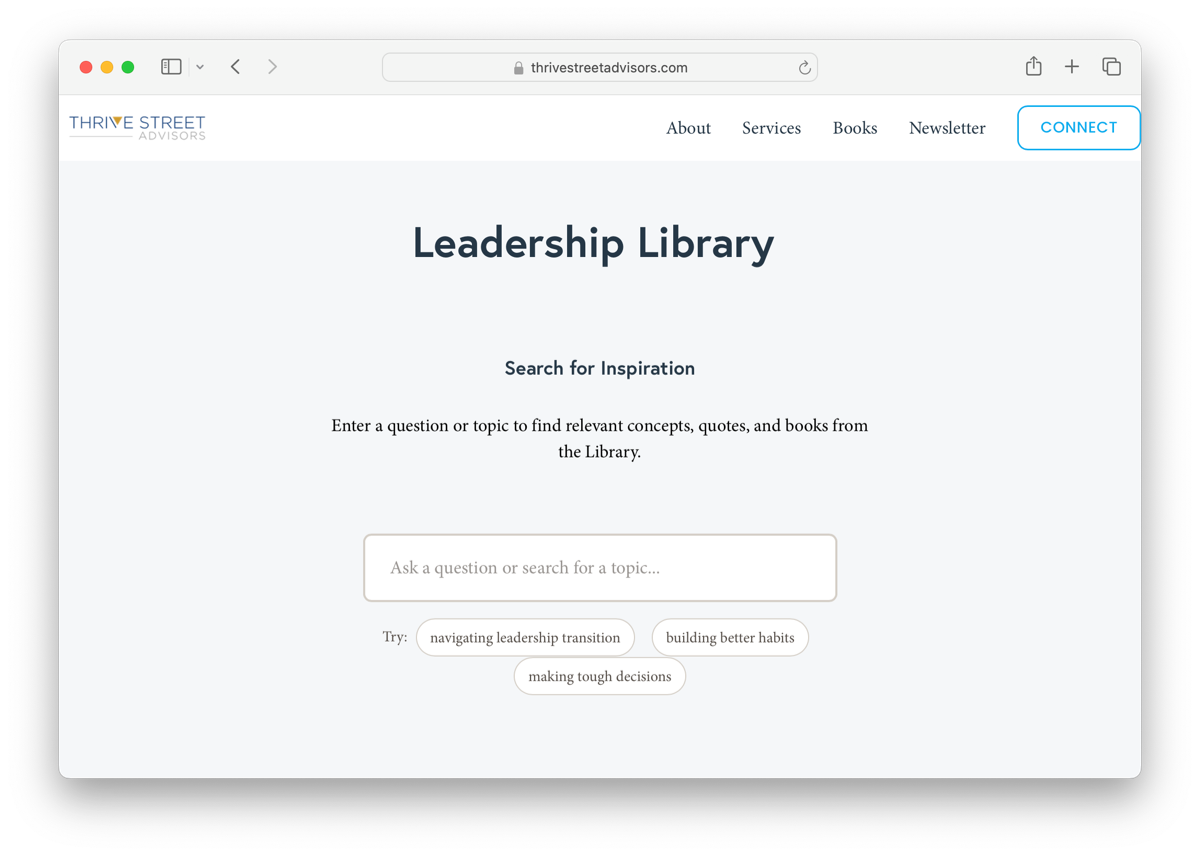
I chose this experiment because it mirrored an AI use case I’ve heard from leaders: How do we make the best information and insights from our organization accessible and usable to everyone else?
As with previous efforts, AI made the technical parts of the project relatively easy. It wrote Python scripts to automate consolidating the disparate files into a single database, which was the core of making the search possible.
However, I quickly realized that building the application was only easy to the extent to which:
I had a spreadsheet of books as the starting point
All of the files were in the same Google Drive folder
All of the files had the name of the book in the title
I had previously labeled “key concepts” and “quotables” from each book
In other words, the data was in a format that could be easily interpreted and organized using simple algorithms.
If your team is like most, I’m sure this is not the case. There’s no clean way to determine a file's contents from its name, the information in the files isn’t uniform or labeled in a way that's easily readable by AI, and many of the files are stored on private laptops rather than in the cloud. Most importantly, much of the critical information—e.g., which of the various documents represents our “best” work, or why and how the documents were created and used in the first place—isn’t in electronic form at all. It’s the brains of people.
The result is that, even if you managed to get all of your organization’s data in one place, it’s not obvious that AI could make it useful.
Several times in my career, I’ve heard organizational leaders propose creating a knowledge management system as part of their strategies. Typically, my reaction is, “Noooooooo! Don’t do it!” I say they’re typically thinking of knowledge management as a technical issue, without understanding how much human effort it takes.
I’d tell them, “If you’re going to create a library, you need to invest in a librarian.” Building the Leadership Library search tool this week only strengthened that belief.
Even with the initial advantage of clean data, it still took a lot of tedious work to make the search tool genuinely useful. For example, the books contained quotes that might make sense in context but were confusing or inane when read out of context. Thus, the AI struggled to properly interpret what was valuable. As a result, I had to review each quote individually to ensure it would make sense.
That is, I had to take on the role of librarian.
Relative to my overall goal to better understand how organizations will need to interact with AI, a few reflections stand out from this experiment.
First, if I were an organizational leader, I wouldn't start with what technology can do. Instead, I'd start with how people would need to change their behavior to actually use the technology well. For example, building a knowledge management system by bringing together the data is straightforward. However, making it strategically useful—i.e., something people actually use—requires ensuring that the library fits naturally into everyone’s workflows.
Consider how this works at universities. Students need to use the university library because professors expect them to cite previous work in their papers. There’s high-quality information in the library because professors can’t get promoted without publishing information that's useful to others. And there are librarians whose job it is to standardize and organize the data. Without the incentives to use, contribute, and curate, the library would be just an expensive piece of real estate.
Moreover, given how much work it takes to clean and structure existing information, I’d also be asking a forward-looking question: What should our team be doing now to ensure the data we’re creating going forward is clean, accessible, and relevant? That may be the difference between building an asset that compounds in value over time and creating a pile of books stored in the basement that no one ever uses.
Optimizing the human system—how the organization creates, curates, and integrates information into everyday work—is more important to generate value from AI than the technology itself.